Enjoyable Turn-based Tactical Game with Demon Fusion – Persona 5 Tactica Review
Persona 5 Tactica is the latest entry in Persona spinoffs and is a tactical JRPG offering a very enjoyable experience.
Going into the game, I had concerns that the game would be a difficult tactical game similar to XCOM. XCOM-like games can be tricky due to factors such as chance-to-hit mechanics and time management. However, Persona 5 Tactica pleasantly surprised me as one of the more accessible XCOM-like games I’ve encountered. Its gameplay is more akin to XCOM-like titles such as Mario + Rabbids (no time management), making it very accessible if you’re not an expert with tactical games. This title is a tactical XCOM-like game and isn’t an SRPG like Tactics Ogre, Final Fantasy Tactics, or Disgaea.
Persona 5 Tactica also provides multiple difficulty options, accommodating players who may not be confident in either tactical games or even with Persona or SMT games in general.
One question is if you need to play Persona 5 or other related games in this in order to enjoy this title. I would highly recommend having played Persona 5, whether it be the original or Royal edition before delving into Persona 5 Tactica. It would be best to familiarize yourself with the characters and be able to understand the intricacies of the Persona 5 lore (such as the metaverse).
Persona 5 Tactica introduces all characters right from the start, not necessarily as playable characters immediately but narratively everyone is introduced from the first cutscene, and in doing so, it retroactively reveals certain key plot points of the original game. The process of recruiting playable characters in Persona 5 is woven into the original game’s narrative, and the mechanics of the metaverse are thoroughly explained.

This review avoids spoilers for all other SMT and Persona games, as well as Persona 5 Tactica itself. Instead, I’ll provide a brief plot synopsis (first few hours) of Persona 5 Tactica and Persona 5 without further spoilers. Persona 5 involves delving into people’s minds and dreams (called the metaverse) to confront malevolent manifestations of themselves, instigating positive changes in their real-world personalities. This core premise remains consistent in Persona 5 Tactica though the overall narrative is much smaller in scope.
You can jump straight into Persona 5 Tactica without the need to explore other Persona 5 spinoff games. Whether you played Persona 5 vanilla or Royal, Tactica accommodates both experiences seamlessly, without referencing the specific divergences found in Royal. There’s no prerequisite to play spinoffs such as Persona 5 Strikers or Persona Q2 either, as these spinoffs contain isolated plots.
Persona 5 Tactica ingeniously blends the XCOM formula with the distinctive elements of Shin Megami Tensei (SMT) and Persona, delivering a fun experience.
You take command of a squad of playable characters, managing three or four characters at a time. The game provides access to the entire original party from the Persona series, granting you a diverse and expansive roster to choose from though you can only choose a few per battle.
The characters in Persona 5 Tactica retain their signature spells from the original games, aligning with their established abilities. For instance, Ann wields fire spells, while Ryuji excels in powerful physical and thunder attacks.
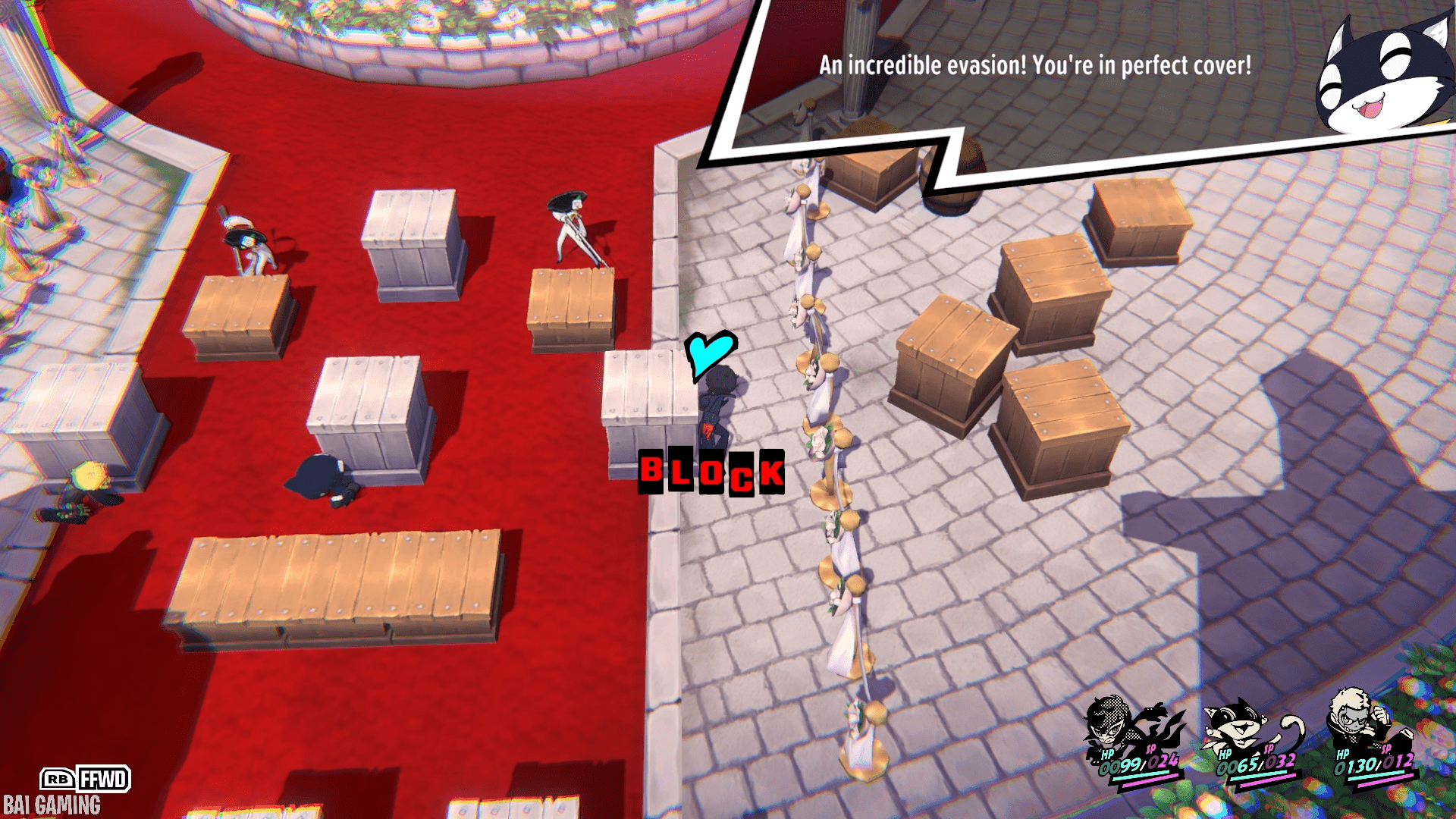
Navigating the game, you actively control characters on a field with the freedom to move continuously within a specified range though the battlefield does have grids. Strategic positioning is crucial as you engage enemies using physical weapons, guns, or spells, and conversely, the enemies and bosses can employ similar tactics against you.
Since this is an XCOM-like title, taking cover behind full or half wall covers provide protection, creating a dynamic where both you and enemies can strategically use the environment for defense. However characters can be knocked out of cover, leaving them exposed to further attacks.
A distinctive feature of Persona 5 Tactica is the departure from the traditional spell weaknesses seen in previous Persona games. Unlike the conventional system where enemies may have specific spell weaknesses all the time (like a Pixie being weak to Dark element and hitting it allows you to get an additional “1 more” turn), this game introduces a different dynamic. The player instead has to strategically displace enemies from cover.
Once they are exposed and vulnerable, any kind of attack can be unleashed to get a “1 more” extra move. You have to be careful and ensure your characters are in cover because if you get knocked out of cover, you can be caught off guard and face a swift game over from repeated enemy attacks.

The enemies in the early stages of the game have no variety, but the game progressively introduces more classes of enemies in later stages. The game maintains a sense of fairness throughout, ensuring that the challenges posed by these new foes remain balanced and never unfair. Kimono enemies with umbrellas can negate all attacks from one side, for example, so often you’d have to go around them to hit them from behind, rewarding efficient movement.
While I found the tutorial very mundane, it serves as a comprehensive guide, covering all of the gameplay mechanics. Enduring the tutorial proves worthwhile, as it equips you with the knowledge needed to navigate the intricacies of the game seamlessly.

Each playable character features a skill tree, offering upgrades to spells, passive abilities, and various stats such as movement range and spell reach, dependent on the character. Accumulating points to enhance the skill tree occurs through main story progression, engaging in conversations within the base, and completing optional quests.
While optional missions may pose a challenge, they reinforce the fundamental gameplay mechanics. The more challenging optional missions require the destruction of all enemies within a single turn. The key to doing well lies in knocking enemies out of their cover and securing as many “1 more” extra moves in order to achieve success.
Like Persona 5, this title features an all-out attack that becomes available after triggering enough 1 more extra moves. This all-out attack is devastating, obliterating all enemies within the triangular formation formed by your characters.
For those who prefer getting through optional missions more easily, grinding for levels and stats provides the option to tackle these optional missions later. Notably, the game offers flexibility by allowing you to reset the skill tree at any time, enabling you to reallocate points without consequences. This feature proves to be a significant quality-of-life improvement, offering peace of mind when experimenting with different skill combinations.
More powerful spells consume additional SP (Spirit Points, which is just this version of MP or magic points), which does add complexity to resource management. While early access to stronger spells is possible, the challenge lies in SP management. For instance, a spell costing 45 SP may not be good if your character’s current SP pool is only 100. I managed to navigate potential challenges by strategically reallocating my skill points, ensuring I reached a higher level that allowed for more frequent spellcasting without depleting all my SP in a single fight.
In comparison to games like Shin Megami Tensei: Nocturne, where forgetting a skill could result in permanent loss of that skill, Persona 5 Tactica stands out with its flexibility. The ability to reassign skill points prevents the stress associated with irreversible decisions and offers a dynamic approach to character development.
The diverse array of characters in Persona 5 Tactica is commendable, allowing players to select characters that align with their preferred play style. What’s particularly appealing is that all characters, regardless of your choice of which to use in battle, contribute to the party’s overall level. The game streamlines progression by applying a single level to the entire party, eliminating the need to grind levels for individual characters. This, coupled with the freedom to switch characters at the start of a battle, provides an enjoyable and flexible gameplay experience.
On lower difficulties, players can switch characters during a stage when a character reaches zero health, offering more opportunities to explore different team dynamics.
Boss fights in Persona 5 Tactica really enhance the game’s depth. While some boss encounters deliver compelling plots, others are definitely overtuned, having extensive waiting and excessive dialogues. Among the boss encounters, there was one boss (not named due to spoilers) that stood out as a challenging and less enjoyable experience. This particular boss wasn’t a boss you fought; rather, you’d have to run to him across a stage full of enemies to land hits while facing his projectile spam from a distance, which deviated from normal Persona boss fights.
It was also disappointing to see recycled bosses right before the conclusion of the game. I don’t mind re-use of enemy types because they’re categorized into familiar classifications like soldiers, heavy tanks, drummer buffer/debuffers and kimono who negate attacks from one side. However, the decision to recycle bosses felt like a large misstep, appearing as an attempt to artificially extend the game length.
I really enjoyed how Persona 5 Tactica seamlessly incorporates elements from the Persona and Shin Megami Tensei (SMT) series into its gameplay. If you’re not familiar, personas or demons represent spirits derived from real-life lore and some fictional entities that characters can harness. Each character possesses a primary persona integral to the narrative, unchangeable by design. However, an intriguing addition to the game is the ability to equip secondary personas to all characters, offering extra skills that weren’t present in previous titles.
The protagonist, commonly known as Joker (though customizable with any name), diverges from having a main persona. His unique gimmick allows him to equip any persona as his main, in addition to equipping any secondary persona as well (though Arsene is his canon persona narratively).
In contrast to mainline SMT and some Persona games where direct negotiation with personas is a common mechanic, Persona 5 Tactica also diverges from this approach. You don’t encounter personas/demons directly in this title, and this game has enemy structures seen in Persona 3 and 4, which featuring generic shadows you fight.
One question you may ask is “How do you recruit new personas and demons?” Upon completing stages, personas are randomly acquired, presenting an opportunity for strategic fusion and customization. Fusing personas not only allows for the creation of powerful new allies, but it also automatically catalogues them in a compendium, enabling subsequent purchases using in-game currency.
The fusion process is a captivating element in Persona 5 Tactica, mirroring the engaging mechanics found in other Persona games. While the depth may not match other titles in the series (you only inherit one skill when fusing), it still remains enjoyable and offers a satisfying level of customization. Even for those less inclined toward XCOM-like gameplay, the allure of persona fusion adds an enticing layer to the overall experience. I don’t particular like XCOM-like tactical games, but the persona/demon fusion really made up for it.


The fusion system serves as a great tool for character customization, permitting the selection of passives and skills that can be equipped onto characters. This flexibility becomes particularly valuable when tailoring characters to specific playstyles. For instance, I opted for SP regeneration across all characters to counterbalance the heightened SP costs associated with higher-tier spells.
A notable change in this game pertains to the evasion skill. This game thankfully has no hit rate like XCOM does, so you don’t need to fear missing a “99% chance to hit” attack. The evasion buffs and debuffs, instead of affecting accuracy, influence a character’s movement range. Eliminating the frustrating hit rate mechanic seen in XCOM games really contributed to a smoother and more enjoyable gameplay experience. Equipment can be purchased and personas can also be transformed into equipment, offering an alternative approach to enhance character capabilities.

Persona 5 Tactica is a well-crafted and self-contained story, especially for a spinoff game. I thought that the plot can even rival that of mainline Persona 5 at certain plot points. However, while the overall plot is great, the game exhibits a distinct imbalance with high highs and low lows.
Certain segments of the narrative tend to drag on, creating pacing issues and great plot events tend to be short bursts of the game, especially the beginning and ending. Although some segments of the game can feel a bit drawn out, the presence of these 2D animations really makes the game more exciting and unique.

Persona 5 Tactica boasts a stellar musical score that enhances the overall atmosphere of the game. While some tracks may be subjective, with a few being hit or miss, fans of Persona 5’s soundtrack are likely to find enjoyment in this installment as well. Although the tracks may not reach the iconic status of “You’ll Never See It Coming,” the music does a commendable job of complementing the game’s themes.
To provide a premise of Tactica, the game begins with Joker and his friends finding themselves in a peculiar world, facing an encounter with a demon bride named Marie who captures Joker’s friends. The plot takes an intriguing turn as Joker embarks on a mission to rescue his captured friends. This unusual opening sets the stage for a distinctive and captivating narrative.

As you delve deeper into the gameplay, the plot of Persona 5 Tactica progressively unveils its layers, evolving into a compelling narrative. The realization dawns that the fantastical world within the game is a manifestation of the distress caused by the imposition of an arranged marriage (this is only the first few hours of plot and really isn’t a spoiler, and going into dream worlds is well-known for Persona 5’s plot).
The introduction of new companions, namely Erina and Toshiro, feel like great additions to the playable cast. Their integration into the plot is seamless, contributing meaningfully to the overarching story. Drawing parallels to Atlus’s history of reintroducing characters in re-released games, it feels like the developers have learned from their mistakes. Previous additions, such as Marie in Persona 4 Golden (not Marie the demon bride) or Alex in Strange Journey Redux felt forced into the plot and didn’t really make sense. Erina and Toshiro are integrated perfectly into Tactica’s plot. This stands in contrast to some past instances where additional characters felt tacked-on.
It makes more sense for the plot of this title to focus on new characters. Joker and the old playable characters had concluded plotlines from Persona 5 and Persona 5: Strikers. It serves as a testament to the developers’ ability to explore fresh narratives even within just a spinoff.
While Persona 5 Tactica offers a captivating plot, its pacing issues are very bad at times. With the game structured into four distinct worlds, the initial world demands a substantial time investment, taking around 10 hours to just confront the first main boss. This prolonged duration can be attributed, in part, to the frontloaded tutorials at the beginning, elongating the learning curve. Fortunately, the subsequent second world has better pacing, delivering very engaging plot developments.
Sadly, the final fourth world experiences a noticeable loss of momentum. Without spoiling, the final boss battle in particular falls prey to being generic and not really being necessary. The final world recycles both enemies and bosses and its aesthetics appear bland, featuring predominantly grey areas that evoke a prototype-like feel. This stands in stark contrast to the vibrant settings of the first three worlds, which included a wedding theme, feudal Japan, and a Japanese school.

If you can get through the final world, you get one of the most amazing game endings I’ve seen.
It may be possible the fourth world is bad due to the game being made too short. The player’s level remains relatively low upon completing the third world, and it might be possible the developers felt the need to extend gameplay and introduce endgame content through the recycling of existing assets. I think that the developers could’ve just scrapped the fourth world entirely and just put the final boss at the end of the third world and show the game ending there, and the game would’ve been just fine.
Persona 5 Tactica stands as a remarkably enjoyable game despite its inherent flaws such as pacing and a poor final world. The game is available on Game Pass at the time of writing. Despite the game’s imperfections, Tactica proves to be surprisingly enjoyable for just being a spinoff game, with a captivating plot that defies your expectations. Even for those experiencing Persona 5 burnout, the developers’ efforts to infuse compelling plot points along with persona/demon fusion and XCOM-like gameplay is a success.
Persona 5 Tactica Review
 Our Score: Good
Pros
- A very outstanding plot with a nice payoff at the very end, although it’s slow at times.
- Very addicting system where you obtain and fuse persona’s/demons. The XCOM-like tactical turn-based gameplay has been modernized. There is no time management in this title.
- The game is different enough from mainline Persona games and will still appeal to those experiencing Persona 5 burnout.
- The pacing is bad at times. The beginning can be very slow, being full of tutorials and taking 10 hours to beat the first major boss.
- The fourth world is very repetitive with recycled bosses, a bland environment, and a nonexistent plotline.
– Brandon Harris
Reviewed on the PC (Gamepass)
Recent Posts