GrimGrimoire OnceMore Review
GrimGrimoire OnceMore is a remaster of the video game GrimGrimoire, a Vanillaware real-time strategy (RTS) game that was originally released in 2007. It’s a very fun and colorful game with a charming art style with plenty of illustrations, addicting gameplay, and a story with many twists and turns. This remaster has plenty of quality of life improvements making the game much more fun and accessible to play. It is available on modern consoles such as the Playstation 4, Playstation 5, and the Nintendo Switch, the latter of which allows the player to play on-the-go.
The game is set in a magical world and follows the story of a young witch named Lillet Blan, who has been accepted into a prestigious magic academy to study wizardry. As Lillet attends classes she interacts with students and teachers, who each have their own personalities and motivations. Over the course of the story Lillet uncovers the dark secrets of the academy.
To put it in a nutshell without giving any spoilers, the storytelling in GrimGrimoire is great, and its world has a lot of rich lore and both likeable and unlikeable characters as well as a vast array of mythical creatures from various folklores. One small flaw is that the plot can get repetitive at times because there is time travel with repeating events and the scope of the plot can be very self-contained, mostly taking place in the magic academy and not other settings.
The game is told over the course of many in-game days, each of which is broken up into cutscenes and battles. The cutscenes are done in a visual novel style, with 2D portraits of characters talking to each other. Both English and Japanese voice acting is available to choose from.

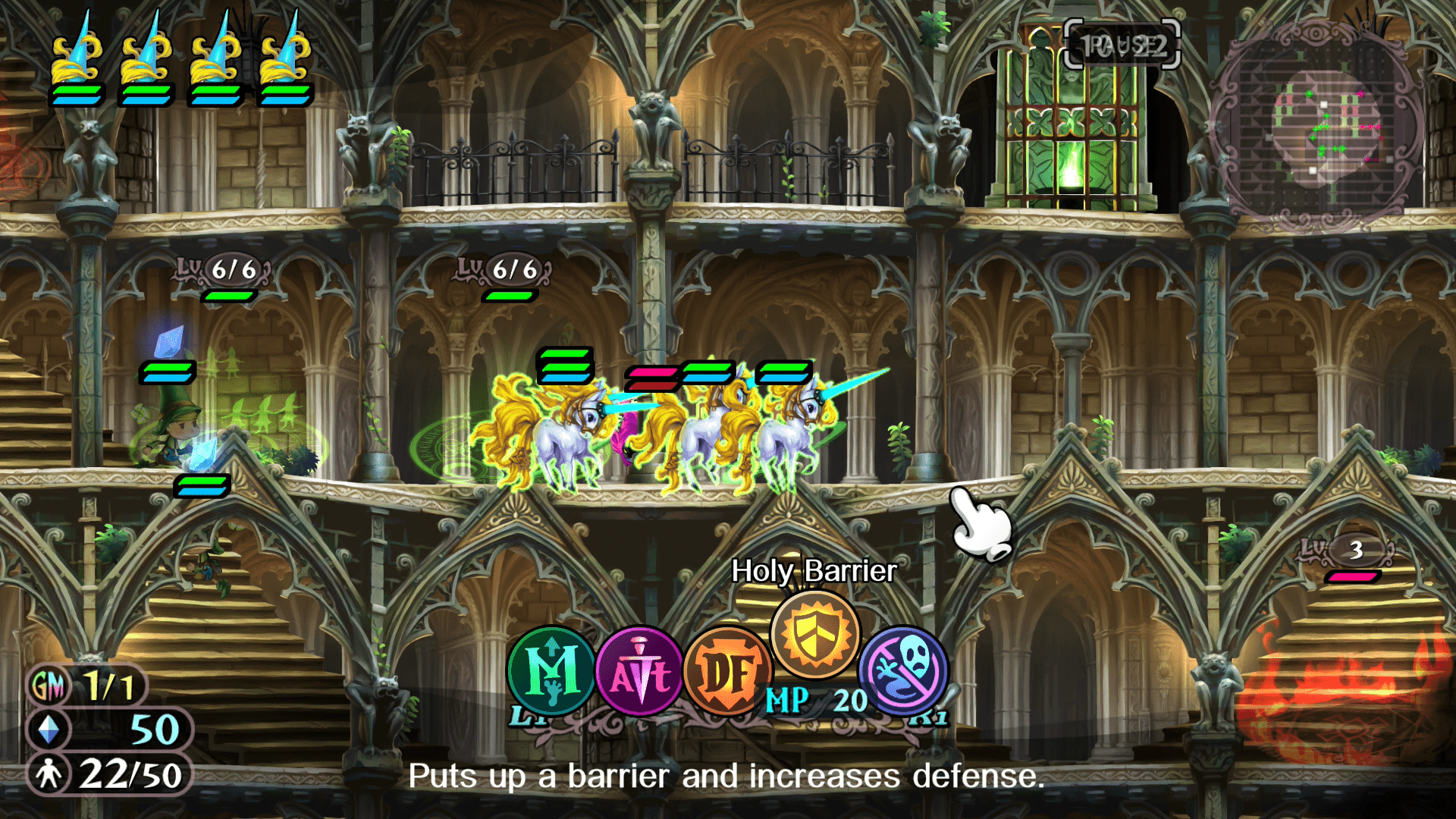
These battles are real-time strategy, meaning the player controls many generic units rather than unique character units and the player has to careful manage their resources to ensure victory. Battles take place on a 2D map with various structures and units that can be controlled by the player. The game provides several tutorial battles and gives the player plenty of opportunity to learn the battle system and the game doesn’t get challenging until much later.
At the start of a battle, the player selects a school of magic to use and begins summoning units and constructing structures. The player can construct structures that provide various benefits to their units and the player can summon units from their school’s structures. Structures can be upgraded with resources, which allow the units to summon to be more powerful, so you have to balance whether you want more units, or if you want to invest into upgrading them and having fewer units. There is a fixed unit limit on the maps as well. Once the player’s units are ready, they can move them across the map to engage with enemy units. The gameplay has “fog of war”, where you can’t see where the enemies are until you’re in range of seeing them.
Battles are real-time, so the player does need to be careful to time their attacks and movements to take advantage of their units’ strengths and avoid their weaknesses. There are many types of units in the game, and certain units may be effective against other units. The player can also cast spells called Grand Magic during battles to provide additional support or deal damage to enemies. The actual mission goals can vary depending on the narrative, with there being a mixture of “defend” maps as well as “wipe out all the enemy” or “destroy all the enemy bases” kind of maps.
During battles, the player must manage their resources carefully. Mana is the currency used to summon units and build/upgrade buildings, and it regenerates slowly over time as your units collect more. The player must balance their mana usage to ensure that they have enough resources to continue summoning units and casting spells throughout the battle. Sometimes it’s worth it to invest into structures that defend against enemy attack early on until you get enough resources to pool an army of units.
You do need to be somewhat efficient to win battles, but compared to other RTS games such as Starcraft 2, this game really does a good job easing you into the battle system and as a player who doesn’t play many RTS games I didn’t find myself overwhelmed by the game’s mechanics. Even if you don’t particularly enjoy RTS games, this is one game worth making an exception for.
The game’s choice of using fantasy creatures is really charming and unique, so instead of seeing “Terran, Protoss, and Zerg” (humans and aliens) races as you’d see in Starcraft you’re now seeing units such as fairies, ghosts, dragons, golems, and gargoyles, just to name a few and this game has four different schools of magic which can be thought of as different races in Starcraft or Warcraft.
Your units also have another division: Astral, meaning they don’t have a physical form (they look like ghosts or spirits), and Substance, meaning they have a physical form (anything not a ghost or spirit). This adds another layer of depth to the game because Astral units are generally immune to physicals attacks. On the other hand, Astral units do take more damage from spells. Some units can use spells to change from Substance form to Astral form, such as the Fairy, so if you see the enemy using physical attacks you can turn your Fairies into Astral beings to dodge their attacks assuming you have the upgrade for it. Substance units can be affected badly by spells such as Sleep, but at the same time can be healed and buffed very easily too.
In this game the non-combat “drones” that collect resources for you are elves for Glamour magic and ghosts for Necromancy magic, just to name a few quick examples, which I found hilarious. I mean this in a good way because it’s refreshing to see such a different take on the RTS genre which has had a drought of games. Usually RTS games will have robots, aliens, or humans, so seeing fantasy creatures, especially drawn in Vanillaware’s art style, is very interesting.
The different creatures all have their small nuances as well, such as elves having to take the stairs to go between lower and upper floors, whereas ghosts can just fly through the floors and have a shorter route as a result. It’s important to take into account the mobility of the different units of mystical creatures. One of my favorite units in the Glamour magic tree was the Morning Star, a highly mobile astral flying type unit who would unleash powerful magic on my enemies.

The remaster only improves upon its original release, which now has the game in widescreen and high-resolution sprites and images. The game now being widescreen is a big improvement because now the player can see more of the screen and move units more easily rather than only being confined to view a small area of the screen.
It has several new big quality of life improvements, such as more options in the skill tree to allow more customization to the player’s units and Grand Magic, which allows powerful offensive or healing magic to be used such as Mana Burst, Resurrection, and a rewind feature just to name a few. A fast-forward option allows players to go through the battles faster. There’s also a new Gallery feature to see all illustrations easily, with over 90 illustrations to view.

There are many difficulty options as well, such as Easy, Normal and Hard, so if you’re not familiar with the RTS genre you can just play on an easier difficulty to experience the story. Previously, Hard was only unlockable after beating all the stages on Normal, but in this game Hard is available from the start though there is a new difficulty that’s even harder that’s unlocked from completing the campaign on any difficulty. There used to be a difficulty called Sweet in the original release not present in this version. With all the quality of life improvements and several newly added abilities, the game is already very fair on Normal difficulty. Interestingly, some unlockable skills are only available on a certain difficulty, and there are some exclusive to Easy mode and even Hard mode, but they don’t make or break the game.
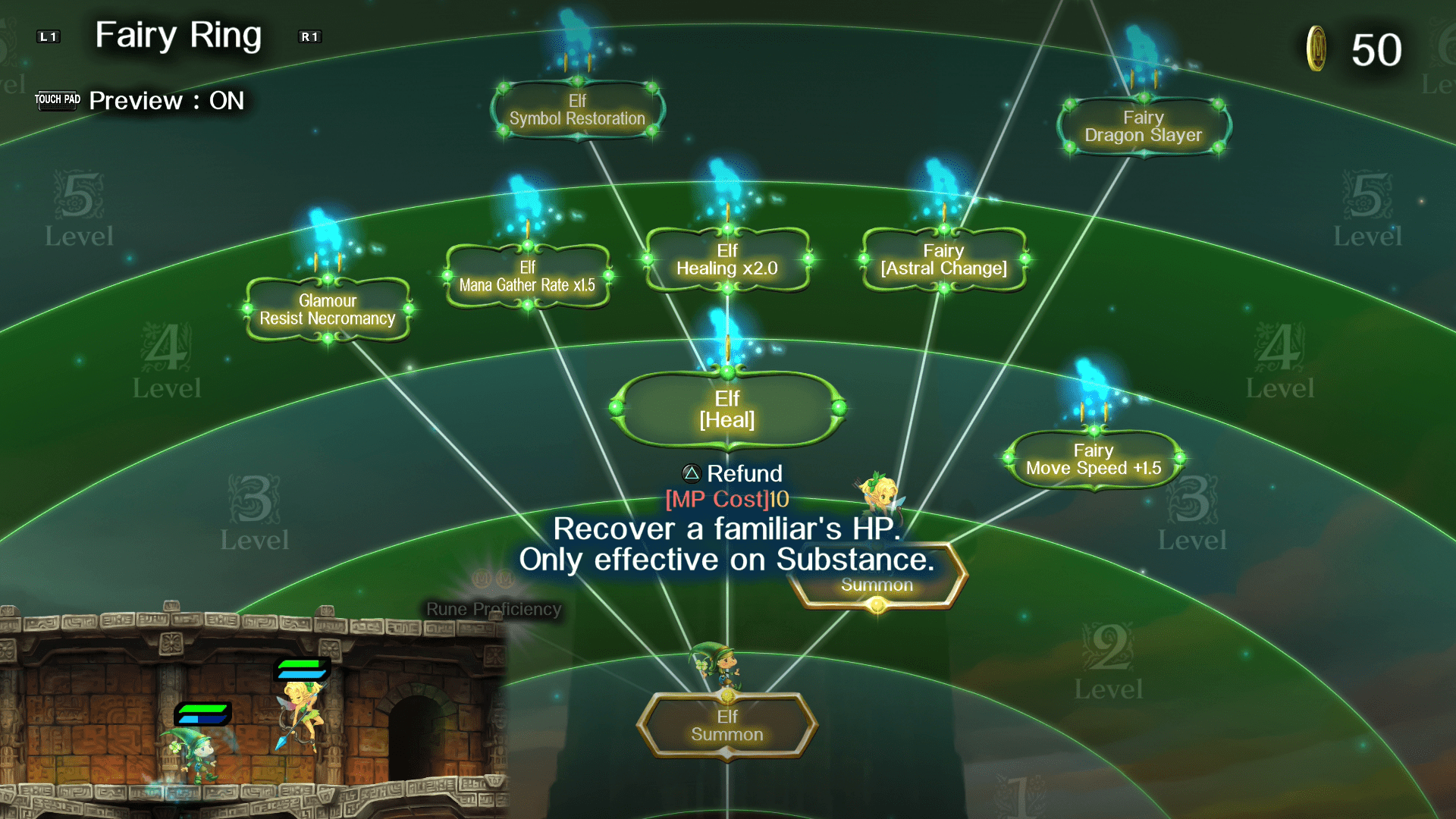
In GrimGrimoire, there are four schools of magic that the player can choose to command during battles, and you unlock them through progressing the story. Each school has its own unique style, strengths, and weaknesses, which can greatly affect gameplay. The schools of magic include Sorcery, Necromancy, Alchemy, and Glamour. They can be thought of as races in Starcraft; however, you can freely use any combination of units you want as long as you progressed the story sufficiently and as long as there’s no restriction on using certain magic due to the narrative (some missions only let you use a certain school of magic).
It’s great to have many different options depending on the situation, and it’s never an overcomplicated system. If you’re struggling, in general you can memorize that: Glamour beats Necromancy, Necromancy beats Sorcery, Sorcery beats Alchemy, and Alchemy beats Glamour. Also remember to use spells against Astral units because they’re immune to physical attacks.
Just as seen in other Vanillaware games, all of the game’s graphics have beautiful 2D illustrations drawn in their style. It’s not cutting edge 3D graphics, but the cutscenes done in a visual novel style and the player and enemy units have really amazing sprites. To give a quick summary of Vanillaware’s art style, their characters are exaggerated a little, but not overly so, and the costumes are very detailed and often reflect the characters’ personalities. The art often has very vibrant colors, making their art look like watercolor paintings.
If you’ve played other Vanillaware works such as Dragon’s Crown, Odin Sphere, or The Thirteen Sentinels, it’s immediately recognizable. It’s definitely one of the cases where I prefer watching 2D characters talking in a cutscene rather than just having realistic face-scanned 3D models, and the extra effort the developers put into designing the characters and the player/enemy units really show, which is extra impressive considering they are a small studio.
What I really loved as well was seeing many guest artists’ illustrations in the game, and this game has an illustration (CG) after every main mission and optional mission. This is probably one of the games with the most illustrations and each image is just so charming.
Put together, the illustrations aren’t the most consistent because different artists have slightly varying styles, but you can really tell that the guest artists enjoyed making their illustrations and this game has some of the best illustrations I’ve seen, generally being very light-hearted and funny to give you a break between stressful missions.


The soundtrack for GrimGrimoire was composed by Hitoshi Sakimoto, an extremely respected composer in the video game industry who is known for his work on other video games such as Final Fantasy Tactics and Valkyria Chronicles. The music in GrimGrimoire definitely goes for a mystical and magical atmosphere that really suits the game’s fantasy setting. The soundtrack definitely becomes emotionally engaging and thematically appropriate during impactful plot events as well, and there were many memorable melodies present.
One small criticism that I have is that the game’s difficulty curve can be steep in the later stages of the game. Additionally, the controls can be a bit clunky at times, particularly when trying to issue orders to multiple units at once. Unfortunately, it would be best to experience RTS titles on a PC with a mouse and keyboard, but the developers did their best to accommodate the controls to make it easy to make with a controller.
They did attempt to simplify the user interface (UI) as much as possible to make controlling the units easier on a console controller, with the most essential information being shown on the screen as well as contextual controls to toggle between different units and different unit modes such as moving, attacking, and defending. These issues are relatively minor and do not detract significantly from the gameplay experience. I reviewed this game on the PS5 with a regular controller, but I would imagine being able to use the touchscreen on the Nintendo Switch to control the units would be a viable option.
Just like the original release of this title, there is no multiplayer present in this remaster which is unfortunate for an RTS game, though I suppose the focus on this title is meant to be Player vs Enemy rather than Player vs Player. There likely was no multiplayer in the original game because it was released on the PS2, a time where there weren’t as many multiplayer games, development for multiplayer was difficult and expensive, telecommunications and internet was not as widespread, fast and stable as it is now, and there was no room for split-screen for local multiplayer because one player’s screen was already squished enough in a 4:3 aspect ratio. Having no multiplayer on this remaster is a small missed opportunity.
Another criticism is that the game is short and I was able to complete the story on Normal difficulty in about 15 hours. The fast forward feature is definitely worth it for longer missions even if it shortens the playtime. You can also do optional missions as well or replay stages on harder difficulties which can add more playtime. It’s good that the game time is not bloated with extremely lengthy cutscenes or repetitive levels, but it would’ve been nice if there was more to the story.
If you’re looking for an immersive strategy game but with a magic flair, GrimGrimoire OnceMore is definitely a remaster worth checking out. It’s a short game and I can see why it might’ve been overlooked when it was originally released in 2007 for the PS2, but it’s genuinely a fun game with a decent story, and the newly added guest illustrations always kept me grinning from ear to ear.
GrimGrimoire OnceMore
 Our Score: Great
Pros
- GrimGrimoire OnceMore is a unique and engaging real-time strategy game that is well worth playing, even if you’re not into RTS games.
- It has charming 2D graphics, intricate storytelling with great voice acting, an amazing soundtrack, and addicting gameplay mechanics.
- Many added quality of life improvements such as widescreen and new skill tree abilities make it a standout title that has aged surprisingly well since its release in 2007.
- Instead of aliens or robots, this strategy game has a lot of fantasy and mythological creatures which is very unique in this genre.
- It unfortunately doesn’t have any local or online multiplayer, which is a missed opportunity for an RTS game.
- The story is on the shorter side and mostly takes place in one setting (the school), and the time traveling plot can get a little repetitive.
– Brandon Harris
Reviewed on Playstation 5
The limited edition version of the game can be pre-ordered on the NIS America website.
Recent Posts