
Home»Math Guides»Physics Conservation of String – Systems of Pulleys Examples
How to solve physics problems involving multiple pulleys using the “conservation of string” trick
We’ll show you how to solve problems involving systems of pulleys.
In problems with systems of pulleys, you actually need to learn to use a trick called the “conservation of string“, it is a means of relating accelerations between different pulleys.
Depending on how string is wrapped around a pulley will make its acceleration different compared to other pulleys!
We’ll work out a generic example involving 2 pulleys, and we’ll plug some numbers in afterwards to show you how to solve these kinds of problems.
Let’s say we have the system of two pulleys as shown below. Weights are referred to as weight 1 and weight 2 on pulleys 1 and 2, respectively.
Notice that the string wrapped around pulley 1 is wrapped around the pulley “twice”, once on each side, whereas pulley 2 is only wrapped on the right.
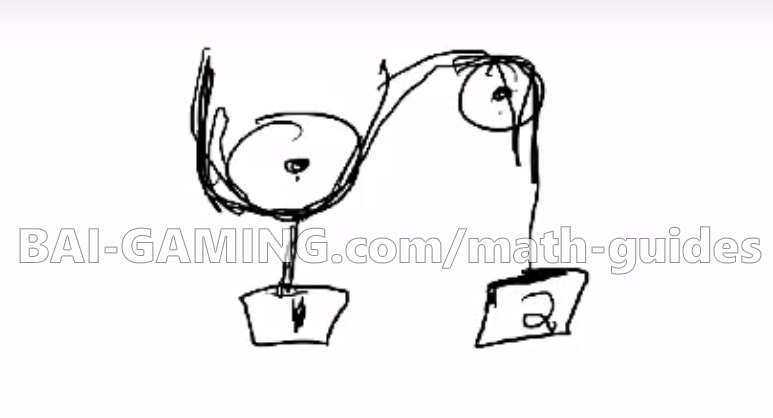
We first need to make equations, which are force balances around each individual weight. Remember that ma = sum of forces. In general the sum of forces includes the force of tension, and the force of gravity on the weight. We say T represents force of tension, and g is gravity acceleration.
\[{m_1}{a_1} = 2T – {m_1}g\]
\[{m_2}{a_2} = T – {m_2}g\]
Notice that we use subscripts, masses 1 and 2 can be different, and the accelerations are certainly different.
Weight 1 has two tensions because each side of the rope will count! How can you solve this?
You actually need to relate the two acceleration values somehow, this is what is known as the conservation of string!
The conservation of string means that the length of string is conserved.
It may be tricky to imagine, but pretend that the pulley system moves, and imagine weight 2 moves down, which means that weight 1 would move upward.
Well, for 1 length of string that weight 2 is pulled down by, weight 1 must be pulled up by 1 length of string. BUT, weight 1 is wrapped around the pulley in an odd way (it’s wrapped with string on each side!), so that means that each side of weight 1 is actually pulled up by 0.5 length of string. Each time weight 2 goes down by 1 unit, weight 1 only goes up 0.5 units.
This means that the second pulley has an acceleration twice as fast as that as the acceleration of the first pulley! In math, this just means:
\[{a_2} = 2{a_1}\]
\[\frac{{{a_2}}}{2} = {a_1} = a\]
We reduced all accelerations into a single acceleration variable, a.
You can generalize this for systems of many pulleys, just equate all of the pulleys’ accelerations at once and call them “a”!
As well, if the weight is wrapped around in weirder ways, such as being wrapped around 3 times or 4 times and the other one is just wrapped on one side then use: a2 = 3a1 or a2 = 4a1, etc. If they’re both wrapped around twice use 2a2 = 2a1, which just cancels out the 2.
Substituting to get “a” in the equations, we get:
\[{m_1}a = 2T – {m_1}g\]
\[2{m_2}a = T – {m_2}g\]
We have two equations and two unknowns. In general we know g, and we will be given m1 and m2 in these kinds of problems. We need to find T and a. You can just plug in the values and use substitution to solve, we will solve by using matrices.
You can also make one of the accelerations positive and one of the accelerations negative if you want, but you don’t have to. The reasoning that the accelerations will be different signs is that you know that if one mass moves up, the other mass moves down, so technically your acceleration has a direction. So you’d guess a direction the pulley system would move in.
But, if you keep the accelerations to be the same sign, you know from the diagram that one will have positive acceleration and the other will have negative acceleration.
We rearrange the system of equations:
\[{m_1}a – 2T = – {m_1}g\]
\[2{m_2}a – T = – {m_2}g\]
Casting into a matrix:
\[\left[ {\begin{array}{*{20}{c}}{{m_1}}&{ – 2}\\{2{m_2}}&{ – 1}\end{array}} \right]\left[ {\begin{array}{*{20}{c}}a\\T\end{array}} \right] = \left[ {\begin{array}{*{20}{c}}{ – {m_1}g}\\{ – {m_2}g}\end{array}} \right]\]
Now let’s plug in some values and solve! Use the image above for the system of pulleys.
Example 1: For the pulley system illustrated, find the acceleration of each pulley and the tension in the rope, given that \(g = 9.8m/{s^2}\), \({m_1} = 5kg\), and \({m_2} = 40kg\)
Substitute the values into the equations we made and solve!
\[\left[ {\begin{array}{*{20}{c}}{{m_1}}&{ – 2}\\{2{m_2}}&{ – 1}\end{array}} \right]\left[ {\begin{array}{*{20}{c}}a\\T\end{array}} \right] = \left[ {\begin{array}{*{20}{c}}{ – {m_1}g}\\{ – {m_2}g}\end{array}} \right]\]
\[\left[ {\begin{array}{*{20}{c}}5&{ – 2}\\{80}&{ – 1}\end{array}} \right]\left[ {\begin{array}{*{20}{c}}a\\T\end{array}} \right] = \left[ {\begin{array}{*{20}{c}}{ – (5)( – 9.81)}\\{ – (40)( – 9.81)}\end{array}} \right]\]
Solving, a is roughly 4.75 m/s2 and the tension is roughly -12.66 N.
The negative tension is fine, it just means that the rope makes the second weight fall downwards. We did that on purpose by purposely making the second weight heavier.
Just be careful, the acceleration of mass 1 is the same, 4.75 m/s2, but the acceleration of mass 2 is actually 2a due to the conservation of string acceleration equations we made previously, which end up being 9.5 m/s2 acceleration for mass 2.
The tension throughout the string is 12.66 N.
Let’s try doing this with the weights reversed!
Example 1: For the pulley system illustrated, find the acceleration of each pulley and the tension in the rope, given that \(g = 9.8m/{s^2}\), \({m_1} = 40kg\), and \({m_2} = 5kg\)
Now we have:
\[\left[ {\begin{array}{*{20}{c}}{40}&{ – 2}\\{10}&{ – 1}\end{array}} \right]\left[ {\begin{array}{*{20}{c}}a\\T\end{array}} \right] = \left[ {\begin{array}{*{20}{c}}{ – (40)( – 9.81)}\\{ – (5)( – 9.81)}\end{array}} \right]\]
Solving, we get: acceleration is 14.72 m/s2 and the force of tension throughout the rope is 98.1 N. The positive tension means that the second weight is pulled up instead. Remember that this means that mass 1’s acceleration is 14.72 m/s2, and that mass 2’s acceleration is 2*a, or 29.44 m/s2.