
Home»Math Guides»Masses connected to pulley on inclined slope with static/kinetic friction
How to solve physics problems with masses on an inclined slope connected by a pulley, with friction
This is a good physics problem where we use concepts such as an incline (involves trigonometry), friction, gravity, and how pulleys work.
You can even see these kinds of problems on final examinations for physics kinematics/mechanics courses because they test many concepts at once!
Consider the following diagram:
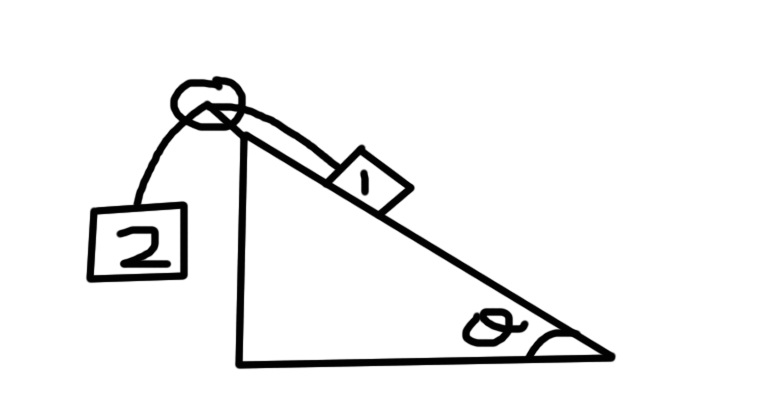
There are two masses connected to a pulley. Mass 2 is hanging down, while mass 1 is on an incline and wants to slide down, but might actually get pulled up instead depending on how heavy mass 2 is.
An angle, theta, is provided, “a certain angle from the horizontal”.
But, we don’t actually know what the direction the system will move in!
It could be that mass 2 is very heavy and pulls mass 1 up the ramp OR mass 1 is heavy and slides down the ramp, causing mass 2 to rise up. But there’s an angle present too, so we can’t entirely judge it by the masses of the objects.
The “proper” way to solve these problems is to find out which direction the system moves in by using all variables except one of the masses and setting the x-axis acceleration to 0. Solve for that mass. We’ll show you how to do so:
The first thing is to develop equations for each mass.
You need horizontal forces for mass 1, vertical forces for mass 1, and vertical forces for mass 2.
Vertical acceleration is always “0” because the object is assumed not to “fly off” the ramp.
We denote T as the force of tension, and Ff as the force of friction.
Consider first that mass 1 slides down the ramp. This is important because friction will be opposite to the direction of movement!
Also, make sure the angle is given like it is in the diagram, “an angle as measured from the horizontal plane”, or else the trigonometry will be off!
The sums in a triangle will equal 180 degrees. If you’re instead given an angle from “the vertical”, it’s best to convert that to an angle from the horizontal. You can work with an angle from the vertical without converting it, but that means that you’ll actually need to reverse your sines with cosines, and your cosines with sines. If the angle theta in the above diagram is 29 degrees, the angle from the vertical is 180-90-29 = 61 degrees. If you didn’t know, sin(29) = cos(61), review trigonometry and triangle rules if you’re not familiar.
For mass 1:
\[{m_1}g\sin \left( \theta \right) – T – {F_f} = {m_1}{a_x}\]
You get this because there’s a component of gravity that’s force trying to pull the mass down the ramp, whereas forces of tension and friction opposite that in the opposite direction. These sum to the mass times the horizontal acceleration.
\[{F_N} – {m_1}g\cos \left( \theta \right) = {m_1}{a_y} = 0\]
\[{F_N} = {m_1}g\cos \left( \theta \right)\]
Remember that vertical acceleration is 0. The normal force and a component of gravity will opposite each other. In other words, the normal force just ends up being a component of gravity as described by the trigonometry.
\[T – {m_2}g = {m_2}{a_x}\]
For the second block, the tension and the force of gravity are in opposing directions, which sum to mass times the acceleration.
Note that the acceleration throughout the rope is the same because it’s a normal, single rope. If you want an example of pulley systems where the acceleration varies due to the way the string is used, see our conservation of string example.
Let’s give some values for the system and solve.
Example: See the image illustrated above. Mass 1 is 7 kg and mass 2 is 11 kg. Angle theta is 29 degrees from the horizontal. The coefficient of static friction is 0.38, and the coefficient of kinetic friction is 0.19. Find the acceleration and the force of tension.
First off: In which direction does the system move? We don’t know, it’s at an angle and neither of the masses look extremely different. Now, you can just assume a direction and solve the system, but that’s not entirely correct.
There’s a trick you can use to find out in which direction the system moves. Pretend you weren’t given mass 2, use the static friction values, set acceleration to be zero, and solve for mass 2’s value twice, flipping the sign of the force of friction. Let’s do so:
Remember that the force of friction is the coefficient multiplied by normal force. And remember we found the normal force in terms of other variables too.
\[{F_f} = {\mu _S}{F_N}\]
\[{F_f} = {\mu _S}{m_1}g\cos \left( \theta \right)\]
And substitute this into the mass 1 horizontal balance:
\[{m_1}g\sin \left( \theta \right) – T – {F_f} = {m_1}{a_x}\]
\[{m_1}g\sin \left( \theta \right) – T – {\mu _S}{m_1}g\cos \left( \theta \right) = {m_1}{a_x}\]
\[T – {m_2}g = {m_2}{a_x}\]
Set the a value equal to zero.
\[{m_1}g\sin \left( \theta \right) – T – {\mu _S}{m_1}g\cos \left( \theta \right) = 0\]
\[T – {m_2}g = 0\]
\[T = {m_2}g\]
\[{m_1}g\sin \left( \theta \right) – {m_2}g – {\mu _S}{m_1}g\cos \left( \theta \right) = 0\]
Plug in all values and solve for mass 2.
\[(7)(9.81)\sin \left( {{{29}^o}} \right) – {m_2}(9.81) – (0.38)(7)(9.81)\cos \left( {{{29}^o}} \right) = 0\]
Solving, mass 2 is roughly 1.07 kg.
Now, repeat this again, but for the friction term in the other direction! So just change the sign of that last term.
\[(7)(9.81)\sin \left( {{{29}^o}} \right) – {m_2}(9.81) + (0.38)(7)(9.81)\cos \left( {{{29}^o}} \right) = 0\]
Solving, mass 2 is roughly 5.72 kg.
Now, why did we do all of this instead of just solving the problem? Why use the static friction, why set acceleration equal to zero, and why solve it for friction in either direction?
Basically, if mass 2 is between 1.1 and 5.7 kg, the system will remain at rest and acceleration equals 0. If mass 2 is under 1.1 kg, it rises and mass 1 goes down the ramp. If mass 2 is over 5.7 kg, it falls and mass 1 goes up the ramp.
Look back at the question statement, it says mass 2 is 11 kg, so it falls and mass 1 will go up the ramp, and the friction for mass 1 will oppose that direction. You could’ve just assumed this from the beginning, but you might’ve been wrong.
Now to actually solve the question, make sure to use kinetic friction coefficient now. You have two equations and two unknowns (tension and acceleration). Make sure friction term opposes the direction of movement.
\[{m_1}g\sin \left( \theta \right) – T + {\mu _k}{m_1}g\cos \left( \theta \right) = {m_1}{a_x}\]
\[T – {m_2}g = {m_2}{a_x}\]
Substitute in values and solve:
\[(7)(9.81)\sin \left( {{{29}^o}} \right) – T + (0.19)(7)(9.81)\cos \left( {{{29}^o}} \right) = (7){a_x}\]
\[T – (11)(9.81) = (11){a_x}\]
\[44.703 = 7{a_x} + T\]
\[ – 107.91 = 11{a_x} – T\]
Solving, a = -3.5 m/s2 and force of tension T = 69.3 N.
WAIT, why is a negative? Ah, it just has to do with the way we assigned the signs, it means that all the signs we used should’ve been flipped around, but it has no effect on the actual calculation and the actual number results we get.
It just means that block 2 falls down, and block 1 goes up the ramp, as expected. Acceleration is just in the “negative” direction.
If you’re still confused, look at the second block equation again after you solved for the variables:
\[T – (11)(9.81) = (11){a_x}\]
We found T = 69.2 N, and -11*9.81 = -107.91 N. There’s less force of tension compared to the force of gravity. That means that the second block must fall due to gravity. If block 2 falls, then block 1 must travel up the ramp as a result. Easy!
Example: Now, let’s quickly repeat the problem with all values being the same, except the mass of object 2 is now 0.5 kg. Now the force of friction is in the opposite direction so we flip the sign of one of the terms in one of the equations, be careful not to forget that or your answer will be off!
\[(7)(9.81)\sin \left( {{{29}^o}} \right) – T – (0.19)(7)(9.81)\cos \left( {{{29}^o}} \right) = (7){a_x}\]
\[T – (0.5)(9.81) = (0.5){a_x}\]
\[21.88 = 7{a_x} + T\]
\[ – 4.905 = 0.5{a_x} – T\]
Solving, acceleration is 2.26 m/s2 and force of tension T is 6.03 N.
Acceleration is now in the “positive” direction, meaning the second block goes up, and the first block goes down the ramp. If you’re still struggling to get which direction everything goes in, just look at the equations again after solving:
\[T – (0.5)(9.81) = (0.5){a_x}\]
That’s the equation for the second block. We found tension to be 6.03 N, and -0.5*9.81 = -4.905 N. There is more tension than gravitational force, meaning that block 2 rises up. If block 2 rises up, then block 1 must travel down the ramp.
Try a physics problem with multiple pulleys involving the “conservation of string” concept